Have you ever stepped out of your office, looked at your car and felt a twinge of guilt? In the gleaming heart of Canary Wharf, your car isn’t just a mode of transport; it is a statement. But London’s microclimate is a relentless adversary. One month, you are battling the corrosive “white gold” of gritted winter roads; the next, you are fighting a losing battle against the fine industrial dust and acidic “gifts” from the city’s bird population.
Maintaining a pristine vehicle in E14 is a unique challenge. Between the humidity of the Thames and the urban heat island effect, your paintwork is under constant chemical attack. If you have ever noticed your car looking “tired” despite regular washes, you aren’t imagining it. The environment is literally eating into your investment.
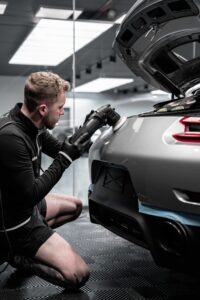
At Narco Works, we don’t just “wash” cars. We provide expert car detailing in Canary Wharf that acts as a tactical shield against the specific pollutants of the London Docklands.
Is Winter Road Salt Quietly Destroying Your Chassis?
Winter in the UK means safer roads, but at a massive cost to your vehicle. Over two million tonnes of road salt are spread across UK roads annually. While essential for traction, this sodium chloride mixture is a nightmare for metal. When salt meets the damp, humid air of the Thames, it creates an electrochemical reaction that accelerates rust formation at an alarming rate.
According to data from UK MOT testing stations, approximately 18% of vehicle failures involve corrosion-related issues. This isn’t just about surface spots; salt-laden slush gets forced into wheel arches, brake lines and chassis seams. If left unchecked, this “hidden” damage can decrease your vehicle’s resale value by up to 20% within just a few seasons.
Professional car detailing in Canary Wharf involves a critical underbody decontamination. We don’t just rinse; we neutralise. By removing the salt deposits from the nooks and crannies where automated washes can’t reach, we stop the oxidation process before it compromises your car’s structural integrity.
Can Summer Dust and “Urban Heat” Bake Damage Into Your Paint?
You might think summer is a “safe” time for your car, but the dangers are simply more subtle. Canary Wharf’s high-density architecture creates a “canyon effect” that traps fine particulate matter – brake dust, construction debris, and carbon soot. When this dust settles on your paintwork and is baked by the midday sun, it can lead to microscopic abrasions and “etching”.
However, the real summer villain is biological. In hot weather, your car’s paint expands. If bird droppings land on the surface, the uric acid (with a pH as low as 3.5) begins to eat into the clear coat. As the temperature drops at night, the paint contracts around the acidic residue, “locking” the damage in. Studies have shown that on a typical 25°C London day, bird droppings can begin to cause permanent visible damage within just 3-5 hours.
- The Acid Attack: Bird droppings are highly acidic and act as a solvent on your car’s protective lacquer.
- Industrial Fallout: Tiny metal particles from nearby railways and construction can “embed” themselves in the paint, leading to tiny orange rust spots known as “rail dust”.
Why Does “Canary Wharf Detailing” Require a Different Approach?
Standard valeting often misses the “London Factor”. Because Canary Wharf is situated on a peninsula surrounded by the Thames, the air has a higher moisture and salt content than more inland areas. This creates a “coastal-urban” hybrid environment where corrosion rates for carbon steel can be 1.5 to 2 times higher than the UK average.
A simple “splash and dash” wash often does more harm than good in these conditions. Rubbing a sponge over a dusty car acts like sandpaper, creating “swirl marks” that dull your reflection under the wharf’s bright streetlights. Professional detailing utilises the “two-bucket method” and pH-balanced chemicals to lift contaminants away without touching – and scratching – the surface.
For the high-value vehicles typical of E14, we recommend a “seasonal reset”. This involves a full decontamination – using clay bars to pull out embedded grit and iron-fallout removers – followed by a ceramic coating or high-grade sealant. This creates a hydrophobic barrier that makes it harder for winter salt or summer dust to bond to the surface in the first place.
Is Ceramic Coating the Ultimate Shield for E14 Drivers?
In a fast-paced environment like the Docklands, convenience is king. Many of our clients ask, “How can I spend less time cleaning and more time driving?” The answer lies in advanced nanotechnology.
Ceramic coatings are no longer just for “show cars”. They are a practical necessity for the daily London commuter. A professional-grade coating provides a permanent or semi-permanent bond to your vehicle’s paint, creating a sacrificial layer that is harder than the factory clear coat.
- UV Protection: Prevents paint oxidation and fading caused by sun exposure in glass-heavy urban environments.
- Hydrophobic Properties: Water, mud, and salt-laden grime simply bead up and slide-off, making your weekly maintenance significantly easier.
According to insurance industry data, vehicles that follow a rigorous protection regimen (like ceramic coating and quarterly detailing) show 70% less environmental damage over a five-year period. It is the difference between a car that looks “used” and one that maintains its “showroom” glow, protecting both your pride and your pocket.
How to Maintain Your Reflection: The Narco Works Philosophy
We know your time is your most valuable asset. That’s why our car detailing in Canary Wharf is designed to fit into your lifestyle, providing long-term protection that survives the London seasons. Don’t wait until you see the “chalky” residue of salt or the dull haze of summer dust to take action. Your car survives the commute; let us help it thrive in the Wharf.
Frequently Asked Questions
- How often should I detail my car if I live or work in Canary Wharf?
For daily drivers in London, we recommend a full professional detail every 3 to 4 months. This aligns with the daily changing seasons, allowing us to remove the specific pollutants (like winter salt or spring pollen) before they cause permanent damage.
- Can I just use an automated car wash to save time?
While convenient, automated “brush” washes are the leading cause of swirl marks and light scratches. The brushes often retain grit from the previous (perhaps much dirtier) car. For the luxury and performance vehicles typical of Canary Wharf, a touchless or hand-detailing approach is essential to preserve the paint’s finish.
- Does detailing really help with the resale value of my car?
Absolutely. A well-maintained car with a documented detailing history can command a 10-15% premium on the private market. Prospective buyers can tell the difference between a car that has been “washed” and one that has been “preserved”.
- What is “Iron Decontamination” and why is it needed in London?
London cars are prone to “brake dust” and “rail fallout” – tiny hot metal shards from braking and nearby DLR/Tube tracks. These particles embed themselves into your paint. Iron decontamination uses a specific chemical that dissolves these particles, preventing them from turning into tiny rust spots.
- Is a ceramic coating worth the investment?
If you plan on keeping your vehicle for more than two years, yes. A ceramic coating significantly reduces the risk of chemical etching (from bird droppings) and prevents the paint from fading. It also makes the car “self-cleaning” to a degree, saving you hours of maintenance time.